
Which language should you train a team in, in Switzerland?
A company in the canton of Vaud wants to train its twelve team leaders. Eight are French speakers, two German speakers, and two work mainly in English. HR proposes what seems the fairest solution: a session in English, which everyone understands.
After half a day, the verdict is clear. Everyone is following. Almost nobody is debating.
Understanding is not enough
A management course is not about listening to a presentation. The essential part happens in the role-plays: conducting a corrective conversation, answering an objection, restating a disagreement without making it worse. These exercises require speaking quickly, with nuance, while others watch.
In a language you understand well but speak less, those moments become costly. Participants simplify what they wanted to say, avoid the exposed exercises, or leave the floor to those who are at ease. The course takes place, but not for everyone.
The right criterion: being able to disagree
To choose the language of a session, the useful question is not “which language does everyone understand?” but “in which language could each person contradict the trainer?”. If the answer differs between participants, it needs to be taken into account rather than aiming for the average.
In practice, there are three cases:
- a homogeneous group: the language is self-evident;
- a mixed group where English really is the working language: a session in English works well;
- a mixed group with no common working language: two sessions are better than one.
What we offer, and what we do not
ABP Consulting delivers its courses in French, English and Spanish. This site is also published in German so that German-speaking teams can understand what we offer, but we do not deliver sessions in German, and we would rather say so here than let it be discovered when you get in touch.
For a German-speaking team used to working in English, a session in English is a real option. For a team that only uses it occasionally, we will say so frankly at our first conversation.
Adapting the format to the language
Language also influences the choice of programme. Courses that centre heavily on spoken practice and role-plays require real ease in the language of the session. The manager-leader toolkit copes better with a group of mixed language levels, because part of the work is done in writing and in small groups.
Finally, Team coaching can deliberately bring together colleagues who speak different languages: in that case, the question of a common language becomes a subject of the work in its own right.
Frequently asked questions
Why doesn't ABP offer courses in German?
Because our trainers deliver in French, English and Spanish, and a management course cannot be improvised in a language you do not master well enough to debate in. We would rather say so clearly: this site is translated into German to be read, but sessions are held in one of those three languages.
Is a course in English suitable for a German-speaking Swiss team?
Often, in companies where English is already the working language. Less so in a team where it is only used occasionally. A good test is to ask future participants whether they would feel able to hold a difficult conversation in English. If the answer is hesitant, the benefit of the course will be limited.
Can two languages be mixed in the same session?
It is possible for informal exchanges, much less so for exercises. A role-play in which one person speaks French and the other replies in English adds a difficulty that is not the one you are trying to work on. For a genuinely mixed group, two separate sessions generally give better results.
Training on this topic
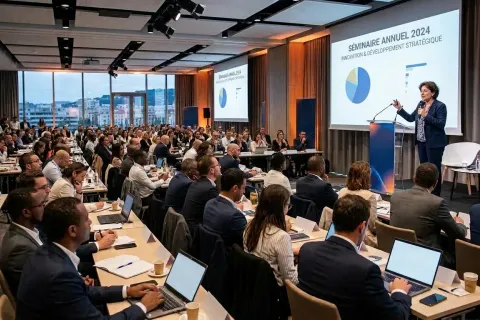
Seminars and team coaching
Team coaching
For a team that no longer decides, two departments passing responsibility back and forth, or a group reshaped after a reorganisation. The work starts with a diagnosis, which may conclude that the problem is not where everyone thought.

Communication and self-awareness
Self-awareness and positive communication
Understand why you communicate the way you do before trying to change anything. Two days: an Enneagram test to place how you operate, then practical techniques to ask, refuse and criticise without attacking.

Management
The manager-leader toolkit
The firm's core programme. Three days to stop settling everything case by case and to have tools that hold: set a frame, correct without humiliating, delegate for real, and adapt how you work to each person.